I haven’t posted in a while. I’m pushing posts that I want to revisit. I have particular love for these:
- Automated Acceptance Criteria
- SVG Takeaways — I want to talk more on how local work flows to production
I haven’t posted in a while. I’m pushing posts that I want to revisit. I have particular love for these:
Java has excellent date-time formatting with the arrival of
java.time (JSR310) in Java 8. I point out that release as it
came with a usable, safe API. (Let us never speak of Calendar
again).
However, I never recall how to format timezone. There are so many options, and it is easy to get is "almost right", but not exactly right.
I'd like to append a "Z" character on the end of a UTC timestamp. OK, let's look at the options, showing only those for timezone/offset:
| Symbol | Meaning | Presentation | Examples |
|---|---|---|---|
| V | time-zone ID | zone-id | America/Los_Angeles; Z; -08:30 |
| v | generic time-zone name | zone-name | Pacific Time; PT |
| z | time-zone name | zone-name | Pacific Standard Time; PST |
| O | localized zone-offset | offset-O | GMT+8; GMT+08:00; UTC-08:00 |
| X | zone-offset 'Z' for zero | offset-X | Z; -08; -0830; -08:30; -083015; -08:30:15 |
| x | zone-offset | offset-x | +0000; -08; -0830; -08:30; -083015; -08:30:15 |
| Z | zone-offset | offset-Z | +0000; -0800; -08:00 |
One thing to be wary of: formatting characters can be doubled, tripled, or quadrupled, and it changes the result. Further, some characters have special rules on repeating (eg, "VV", and "O" vs "OOOO").
The best way to understand what to use is to try them all:
final var when = ZonedDateTime.of(
        LocalDate.of(2011, 2, 3),
        LocalTime.of(14, 5, 6, 7_000_000),
        ZoneId.of("UTC"))
        .toInstant();
for (final String tzFormat
        : List.of("VV", "v", "z", "zz", "zzz", "zzzz", "O", "OOOO", "X", "XX", "XXX",
        "XXXX", "x", "xx", "xxx", "xxxx", "Z", "ZZ", "ZZZ", "ZZZZ")) {
    System.out.println(
            tzFormat + " - " + DateTimeFormatter
                    .ofPattern("yyyy-MM-dd'T'HH:mm:ss" + tzFormat)
                    .withZone(ZoneId.of("UTC"))
                    .format(when));
}
Producing:
VV - 2011-02-03T14:05:06UTC
v - 2011-02-03T14:05:06UTC
z - 2011-02-03T14:05:06UTC
zz - 2011-02-03T14:05:06UTC
zzz - 2011-02-03T14:05:06UTC
zzzz - 2011-02-03T14:05:06Coordinated Universal Time
O - 2011-02-03T14:05:06GMT
OOOO - 2011-02-03T14:05:06GMT
X - 2011-02-03T14:05:06Z
XX - 2011-02-03T14:05:06Z
XXX - 2011-02-03T14:05:06Z
XXXX - 2011-02-03T14:05:06Z
x - 2011-02-03T14:05:06+00
xx - 2011-02-03T14:05:06+0000
xxx - 2011-02-03T14:05:06+00:00
xxxx - 2011-02-03T14:05:06+0000
Z - 2011-02-03T14:05:06+0000
ZZ - 2011-02-03T14:05:06+0000
ZZZ - 2011-02-03T14:05:06+0000
ZZZZ - 2011-02-03T14:05:06GMT
What an exciting list! "zzzz" is rather wordy, and it's unclear what "ZZZZ" is doing. Actually, the whole list is even more iteresting for timezones other than UTC.
Since the goal is to append a "Z", the simplest choice is:
yyyy-MM-dd'T'HH:mm:ssX.
Why didn't I just use DateTimeFormatter.ISO_INSTANT, which is
documented to produce the "Z"? I want a timestamp that is to only seconds-precision,
and the format for "ISO_INSTANT" includes milliseconds.
After too much Internet searching, I was unable to find an easy solution to repeated duplication in my Spring MockMVC tests of REST controller endpoints. For years now, the endpoints we write have typically sent or received JSON. This is what I mean:
mockMvc.perform(post("/some/endpoint")
        .contentType(APPLICATION_JSON_UTF8)
        .accept(APPLICATION_JSON_UTF8)
        .content(someRequestJson))
        .andExpect(status().isCreated())
        .andExpect(header().string(CONTENT_TYPE, APPLICATION_JSON_UTF8_VALUE))
        .andExpect(header().string(LOCATION, "/some/endpoint/name-or-id"))
        .andExpect(content().json(someResponseJson));
All the repeated "APPLICATION_JSON_UTF8"s, in every controller test!
If there is an existing Spring testing solution, I'd love to hear about
it. Rather than wait, I wrote up a small extension of
@WebMvcTest to default these values.
First, an annotation for Spring to use in setting up a
MockMvc (javadoc elided):
@Documented
@Import(JsonMockMvcConfiguration.class)
@Retention(RUNTIME)
@Target(TYPE)
@WebMvcTest
public @interface JsonWebMvcTest {
    @AliasFor(annotation = WebMvcTest.class)
    String[] properties() default {};

    @AliasFor(annotation = WebMvcTest.class)
    Class[] value() default {};

    @AliasFor(annotation = WebMvcTest.class)
    Class[] controllers() default {};

    @AliasFor(annotation = WebMvcTest.class)
    boolean useDefaultFilters() default true;

    @AliasFor(annotation = WebMvcTest.class)
    ComponentScan.Filter[] includeFilters() default {};

    @AliasFor(annotation = WebMvcTest.class)
    ComponentScan.Filter[] excludeFilters() default {};

    @AliasFor(annotation = WebMvcTest.class)
    Class[] excludeAutoConfiguration() default {};
}
Note it is a near exact lookalike of @WebMvcTest (minus
the deprecated parameter). The important bits are:
@WebMvcTest, a kind of
extension through composition.
@Import to bind custom configuration to this
annotation.
@WebMvcTest, so this annotation is a drop-in
replacement of that one.
Next a configuration class, imported by the annotation, to customize
MockMvc:
@Configuration
public class JsonMockMvcConfiguration {
    @Bean
    @Primary
    public MockMvc jsonMockMvc(final WebApplicationContext ctx) {
        return webAppContextSetup(ctx)
                .defaultRequest(post("/")
                        .contentType(APPLICATION_JSON_UTF8)
                        .accept(APPLICATION_JSON_UTF8_VALUE))
                .alwaysExpect(header().string(
                        CONTENT_TYPE, APPLICATION_JSON_UTF8_VALUE))
                .build();
    }
}
Some points about this class:
@Primary is not necessary for Spring, but helped
IntelliJ — perhaps I got lucky with Spring without
@Primary, and IntelliJ highlighted a real problem.
defaultRequest(...)
working. I was unable to (re)implement the relevant interfaces, and
eventually found that passing any
MockHttpServletRequestBuilder sufficed. Spring
"merges" (overlays) the actual request builder from the test over
this default, replacing POST and "/" with whichever
HTTP method and path the test uses (eg,
GET "/bob"). Only the header customization is used.
Example usage:
@JsonWebMvcTest(SomeController.class)
class SomeControllerTest {
    @Autowired
    private MockMvc jsonMockMvc;

    @Test
    void shouldCheckSomething()
            throws Exception {
        jsonMockMvc.perform(post("/some/endpoint")
                .content(someRequestJson))
                .andExpect(status().isCreated())
                .andExpect(header()
                        .string(LOCATION, "/some/endpoint/new-name"))
                .andExpect(content().json(someResponseJson));
    }
}
See the Basilisk project for source code and sample usage. (Basilisk is a demonstration project for my team illustrating Spring usage and conventions.)
During my first stint at ThoughtWorks, I paired with Gregor Hohpe on implementing messaging patterns while he worked with Bobby Woolf on Enterprise Integration Patterns (EIP). To this day, this remains one of my favorite technical books. In conversation I was always struck by Gregor's meticulous "napkin diagrams" as he illustrated the point he was making.
One output from that pairing was to experiment with using messaging patterns within a single program, not just between programs. So I wrote the "Magic Bus" library in Java, using reflection, to connect publishing and subscribing components within a web services backend.
While working a new project, I find myself diagramming one of our backend services using EIP's notations for messaging patterns. And I recalled "Magic Bus".
I thought I had long ago lost the source code, but found some
JVM .class files in a forgotten directory. IntelliJ to
the rescue! Using JetBrain's
excellent Fernflower decompiler, I recovered a later stage of
"Magic Bus" after I had converted it to typesafer generics and dropped
reflection.
That code is now in public GitHub, brought up to Java 11, and cleaned up.
If I recall correctly, I originally dropped "Magic Bus" after Guava's Event Bus came along. What makes "Magic Bus" different from Event Bus? Not too much, actually. The main feature in "Magic Bus" lacking in Event Bus is subscribing to message handler exceptions: in Guava one instead registers a global callback to handle exceptions.
It took far more research time than I expected. The goal:
Output an OffsetDateTime with offset for Zulu
(OTC) timezone as +00:00.
I have a project where a 3rd-party JSON exchange expected
timestamps in the format 01-02-03T04:05:06+00:00. We're
using Jackson in a Java project. All the default configuration I
could find, and trying all the "knobs" on Jackson I could find, led
to: 01-02-03T04:05:06Z. Interesting, as any non-0 offset
for timezone produced: 01-02-03T04:05:06+07:00 rather
than a timezone abbreviation: Zero offset is special.
Finally, circling back to the JDK javadocs yet again, I spotted what I had overlooked many times before:
Offset X and x: This formats the offset based on the number of
pattern letters. One letter outputs just the hour, such as '+01',
unless the minute is non-zero in which case the minute is also output,
such as '+0130'. Two letters outputs the hour and minute, without a
colon, such as '+0130'. Three letters outputs the hour and minute, with
a colon, such as '+01:30'. Four letters outputs the hour and minute and
optional second, without a colon, such as '+013015'. Five letters
outputs the hour and minute and optional second, with a colon, such as
'+01:30:15'. Six or more letters throws
IllegalArgumentException. Pattern letter 'X' (upper case)
will output 'Z' when the offset to be output would be zero, whereas
pattern letter 'x' (lower case) will output '+00', '+0000', or '+00:00'.
The key is to use lowercase 'x' in the format specification. So my problem with Jackson became:
    @JsonFormat(pattern = "yyyy-MM-dd'T'HH:mm:ssxxx")
    private final OffsetDateTime someOffsetDateTime;
And the result is the desired, 01-02-03T04:05:06+00:00.
Now I can return to more interesting problems.
Essentially, exceptions are a form of structured, non-local
goto with stack unwinding.
"Structured" here means "higher level than the
machine" (a matter of taste/opinion), and "non-local"
means "beyond a single function/method".
What this means is that you can replace code like (in "C"):
int bottom()
{
    int things_go_wrong = -1; // For illustration

    if (things_go_wrong) goto error;
    return 0;

error:
    return -1;
}

int
middle()
{
    if (-1 == bottom()) goto error;
    return 0;

error:
    return -1;
}

void
top()
{
    if (-1 == middle()) {
        handle_failure();
    }
}
With code like (in Java):
public class A {
    void botton() {
        boolean thingsGoWrong = true; // For illustration

        if (thingsGoWrong) throw new ThingsWentWrong("So wrong!");
    }

    void middle() {
        bottom();
    }

    void top() {
        try {
            middle();
        } catch (ThingsWentWrong e) {
            handleFailure();
        }
    }
}
"Unwinding" here means the compiler or runtime treats
intermediate calls (the stack) the same as if returning
normally (for example, the stack pointer is moved back;
and in a language like C++, destructors are executed), and
program execution resumes in the catch block.
It is "structured" in the sense that it is not the same as a
direct goto to the resume point. This is not
possible in standard "C" or C++ (or in Java), which only
suppport local labels within functions. The equivalent in "C"
and C++ is to use setjmp and
longjmp for a non-local goto, and forget
all about deallocating memory or calling destructors. (As odd as
this sounds, it is needed for call-with-continuation,
an important feature in
LISP-like languages).
All human endeavors build on the work of those who came
previous. Exceptions are no exception. They are the
result of 1960s and 1970s programmers
wanting an easier way to deal with
exceptional conditions. This is not completely identical
with "errors", which may sometimes be better represented with
a simple boolean true/false return.
Like any sharp instrument, do not abuse it.
I filed this issue with Atlassian about JIRA:
You make it incredibly difficult to report issues about JIRA itself:

 * I cannot use Markdown in the editor.  You are the only tool I use which does
   not support markdown.  This is one of the top reasons I recommend against
   using JIRA to clients  Ex: quoting code with single backticks, or code blocks
   with tripple backticks
 * Finding the issue tracker for JIRA is a PITA.  Even after finding it, when
   creating a new issue, it offers a dialog/link that takes me back to the
   beginning
 * The web pages for a team project does not have any easy way to report JIRA
   issues to Atlassian
 * How do I find out the version of JIRA software in use when I report problems?
 * Reporting to you, you _require__ a component, and severity.  Which component
   should I pick?  I don't know how your product is architected, so I guessed
   at one.  And "affected version"?  Heck if I know.  Really, you can't
   provide a link on a cloud JIRA board which fills this in automatically?
 * In a dropdown for picking what Atlassian product to report against, the text
   describing them is cut off.  So when it says "XXX (includi)" I have no idea
   what it is including
Only .. I didn't. Their publicly accessible issue tracker does not let me file issues.
We recently migrated a medium-sized Java project to Spring Boot 2 from version 1. One of the challenges was migrating to the JDK date-time library from Joda. It turns out that Spring Boot 2 has excellent native support for JDK date-times, as does Jackson (JSON) and Hibernate (database), the default technologies offered by Spring Boot 2 for these features.
The migration itself went smoothly, which is unsurprising given the fantastic work of Stephen Colebourne in designing JDK date-time support based on his authorship of Joda.
So we looked at disabling Joda completely in our Gradle build. The most concise approach we found was:
configurations {
    compile.exclude group: 'joda-time'
}
This removed Joda completely from configurations (classpaths) related to Java. However, this had unintended side effects:
We easily found a workaround for SpringFox, but not for OpenSAML.
(If you're curious, yes, we do intent to migrate from OpenSAML 2
(desupported in 2016) to OpenSAML 3; however, we would like
spring-security-saml2-core support first.)
The exclusion in the compile configuration does
exactly what we need: Joda disappears! But what to do
about SpringFox and OpenSAML?
For the Spring Boot runtime classpath, there is another concise solution, though finding it was rather troublesome, and it is not well-documented by Pivotal or in Stack Overflow.
First, we setup another classpath of our own making named bootRuntime:
configurations {
    // Other parts of "configurations", including the Joda exclusion from above

    bootRuntime // Synthetic configuration for deps needed *only* to launch app
}
Then we added Joda to that synthetic classpath relying on Spring Boot plugin's definition for the version of Joda to use:
dependencies {
    // Other parts of "dependencies"

    bootRuntime 'joda-time:joda-time'
}
Lastly, we taught Spring Boot to include this synthetic classpath when launching our app (this was the trickiest part):
bootJar {
    bootInf {
        from configurations.bootRuntime
        into 'lib'
    }
}

bootRun {
    classpath += configurations.bootRuntime
}
This adds Joda to the runtime classpath for both the single "fat
jar" built by Spring (bootJar), and when launching
the app on the command line with gradle (bootRun).
Unless you are a heavy Gradle user, from ... into ...
syntax may be unfamiliar: this copies the jars in the synthetic
configuration into the fat jar at the location Boot expects to find
them. The "'lib'" is literally a directory location within the
jar. Useful magic, but a bit obtuse. The outcome:
$ jar tf build/libs/the-project.jar | grep joda-time
BOOT-INF/lib/joda-time-2.9.9.jar
As a matter of fact, Joda is the very last file in the boot jar,
a suggestion that it was added by our bootInf section
after the Boot plugin built the jar.
(Our workaround is intentionally small. If we're unable to make
it work, we'll switch to brute-force library exclusions in our
dependencies lists. The goal is to prevent accidental import
from Joda, for example, of LocalDate.)
For running the boot app, this solution is great: it is small, readable, easy to maintain, and it works. However, for tests which exercise our user authentication with OpenSAML, it fails. Joda is not in the test classpath, and we cannot use or mock OpenSAML methods which use Joda types.
Barring another magical solution like bootRuntime,
we'll fall back on manually excluding Joda from each dependency,
and adding it back in to the test classpath. A pity given how
pithy the solution is with exclusion from the
compile configuration.
Kotlin does many wonderful things for you. For example, the data classes
create helpful constructors, and automatically implement
equals and hashCode in a reasonable
way.
Similarly, JPA works magic—expecially in the context of Spring Data.
So how do I test that my Kotlin entity is correctly annotated for JPA? The simplest thing would be a "round trip" test: create an entity, save it to a database, read it back, and confirm the object has the same values. Let's start with a simple entity, and the simplest possible test:
@Entity
data class Greeting(
        val content: String,
        @Id @GeneratedValue
        val: Int id = 0)
@DataJpaTest
@ExtendWith(SpringExtension::class)
internal class GreetingRepositoryIT(
        @Autowired val repository: GreetingRepository,
        @Autowired val entityManager: EntityManager) {
    @DisplayName("WHEN saving a greeting properly annotated")
    @Nested
    inner class Roundtrip {
        @Test
        fun `THEN is can be read back`() {
            val greeting = Greeting("Hello, world!")

            repository.saveAndFlush(greeting.copy())
            entityManager.clear()

            assertThat(repository.findOne(Example.of(greeting)).get())
                    .isEqualTo(greeting)
        }
    }
}
Some things to note:
saveAndFlush on the Spring
repository, rather than entityManager.flush(),
which requires a transaction, and would add unneeded
complexity to the test.
But this test fails! Why?
The unsaved entity (remember, we made a copy to keep the
original pristine) does not have a value for id,
and the entity read back does. Hence, the automatically
generated equals method says the two objects
differ because of id (null in the
original vs some value from the database).
Further, the Spring Data QBE (QBE) search
for our entity includes id in the search criteria. Even
changing equals would not address this.
What to do?
It turns out we need to address two issues:
equals takes id into
account, but we are only interested in the data values, not
the database administrivia.
repository.getOne(saved.id), I'd prefer to
keep using QBE, if the code is reasonable.
To address equals, we can rely on
an interesting fact about Kotlin data classes: only
default constructor parameters are used, not properties in the
class body, when generating equals and
hashCode. Hence, I write the entity like this,
and equals does not include id, while
JPA is stil happy as it relies on getter reflection:
@Entity
data class Greeting(
        val content: String) {
    @Id
    @GeneratedValue
    val id = 0
}
To address the test, we can ask QBE to ignore id when fetching our saved entity back from the database:
@DataJpaTest
@ExtendWith(SpringExtension::class)
internal class GreetingRepositoryIT(
        @Autowired val repository: GreetingRepository,
        @Autowired val entityManager: EntityManager) {
    @DisplayName("WHEN saving a greeting properly annotated")
    @Nested
    inner class Roundtrip {
        @Test
        fun `THEN is can be read back`() {
            val greeting = Greeting("Hello, world!")

            repository.saveAndFlush(greeting.copy())
            entityManager.clear()

            val matcher = ExampleMatcher.matching()
                    .withIgnoreNullValues()
                    .withIgnorePaths("id")
            val example = Example.of(greeting, matcher);

            assertThat(repository.findOne(example).get()).isEqualTo(greeting)
        }
    }
}
In a larger database, I'd look into providing an
entity.asExample() to avoid duplicating
ExampleMatcher in each test.
The closest to Kotlin's data classes for JPA entities is Lombok's
@Data annotation, together with
@EqualsAndHashCode(exclude = "id") and
@Builder(toBuilder = true), however the
expressiveness is lower, and clutter higher.
The test would
be largely the same modulo language, replacing
greeting.copy() with
greeting.toBuilder().build(). Alternatively,
rather than a QBE matcher, one could write
greeting.toBuilder().id(null).build().
This last fact leads to an alternative with Kotlin: include
id in the data class' default constructor, and in
the test compare the QBE result as
findOne(example).get().copy(id = null) without
a matcher.
What Kotlin JPA patterns have you discovered?
My team is working on a Java server, as part of a larger project project, using Gradle to build and JaCoCo to measure testing code coverage. The build fails if coverage drops below fixed limits (branch, instruction, and line)—"verification" in JaCoCo-speak.
We follow the strategy of The Ratchet: as dev pairs push commits into the project, code coverage may not drop without group agreement, and if coverage rises, the verification limits rise to match. This ensures we have ever-rising coverage, and avoid new code which lacks adequate testing.
At a work project, we're struggling to get JaCoCo to ignore some new, configuration-only Java classes. These classes have no "real" implementation code to test, are used to setup communication with an external resource, yet are high line-count (static configuration via code). So they drag down our code coverage limits, and there is no effective way to unit test them sensibly. (They are best tested as system tests within our CI pipeline using live programs and remote resources.)
JaCoCo has what seems at first blush a sensible way to exclude these configuration classes from testing:
jacocoTestVerificationCoverage {
    violationRules {
        rule {
            excludes ['hm.binkley.labs.saml.SomeConfig']
            limit {
                counter = 'LINE'
                minimum = 0.90
            }
        }
    }
}
Unfortunately, this does nothing. There is no warning or error, and coverage continues to include the whole code base.
After a lot of experimenting and StackOverflow research, this answer from Juan Vimberg worked exactly as we needed. Following his approach:
final def excludedClasses = ['hm.binkley.labs.saml.SomeConfig']

jacocoTestVerificationCoverage {
    violationRules {
        rule {
            limit {
                counter = 'LINE'
                minimum = 0.90
            }
        }
    }

    afterEvaluate {
        classDirectories = files(classDirectories.files.collect {
            fileTree(dir: it, excludes: excludedClasses.collect {
                it.replace('.', '/') + '.class'
            })
        })
    }
}
The list of excluded classes is extracted so the same trick can be used in the generated reports:
jacocoTestReport {
    executionData test, databaseTest
    reports {
        html.enabled = true
        xml.enabled = true
        csv.enabled = false
    }
    afterEvaluate {
        classDirectories = files(classDirectories.files.collect {
            fileTree(dir: it, excludes: excludedClasses.collect {
                it.replace('.', '/') + '.class'
            })
        })
    }
}
Something to consider: using wildcards
(hm.binkley.labs.saml.*) may take additional work.
Why does this work, and the "obvious" way does not?
JaCoCo has more than one notion of scoping. The clearest one is the counters: branches, classes, instructions, lines, and methods.
Not as well documented is the scope of checks: bundles, classes, methods, packages, and source files. These are not mix-and-match. For example, exclusions apply to classes. Lyudmil Latinov has the best hints I've found on how this works.
I'd like to use jenv on my Cygwin setup at home. Oracle has
moved to a 6-month release pace, and so I find myself dealing with
multiple Java major verions. However, my tool of choice, jenv,
does not play well with Cygwin.
(Note: There are two jenvs out there. I am talking
about jenv.be, not jenv.io. Apologies that neither does
HTTPS well.)
As a workaround, I wrote a straight-forward shell function to provide the minimum I need: switch between versions in the current shell:
# Until jenv.be supports Cygwin
function set-java {
    local -a java_v
    local jdk v OPTIND
    for jdk in /cygdrive/c/Program\ Files/Java/jdk*
    do
        jdk="${jdk/\/cygdrive\/c\/Program\ Files\/Java\/jdk/}"
        v=${jdk#-}
        v=${v#1.}
        v=${v%%.*}
        java_v[$v]=$jdk
    done

    local verbose=false
    while getopts :hv opt
    do
        case $opt in
        h ) cat <<EOH
            Usage: $FUNCNAME [-hv] VERSION

            Options:
            -h Print help and exit
            -v Verbose output

            Arguments:
            VERSION One of ${!java_v[@]}
            EOH
            return 0 ;;
            v ) verbose=true ;;
            * ) echo "Usage: $FUNCNAME [-hv] VERSION" >&2 ; return 2 ;;
        esac
    done
    shift $((OPTIND - 1))

    case $# in
    1 ) ;;
    * ) echo "Usage: $FUNCNAME [-hv] VERSION" >&2 ; return 2 ;;
    esac

    if ! [[ ${java_v[$1]+foo} ]]
    then
        echo "$FUNCNAME: No such Java version: $1.  Try $FUNCNAME -h" >&2
        return 2
    fi

    export JAVA_HOME='C:\Program Files\Java\jdk'${java_v[$1]}
    for v in ${!java_v[@]}
    do
        case $v in
        $1 ) ;;
        * ) export PATH="${PATH//${java_v[$v]}/${java_v[$1]}}" ;;
        esac
    done

    if $verbose
    then
        echo "$FUNCNAME: Updated JAVA_HOME and PATH for JDK to $v at $JAVA_HOME"
    fi
}
Try the -h flag (help).
What is my dream story card? I don't mean: What's the story I'd most like to work on! I mean: What should a virtual story card look like (as opposed to card stock on a wall)? This may be a trivial question. But for me the user experience working with stories is very important: I work with them daily, write them, discuss them, work on them, accept them, etc. I want the feel of the card to be thoughtful, like that fellow to the right.
And more than that. I am lazy, impatient, hubristic. The acceptance criteria, I want them testable, literally testable in that each has a matching test I can execute. Given my laziness, I don't want to switch systems and run tests; I'd like to execute acceptance criteria directly from the story card.
So is there a system like that today? No. There are bits and pieces though.
Some story card systems are particularly awkward to read, understand or use. Special demerits for:
Post-development testing on this team is a fairly ordinary role. The developers say: a new web page is ready. Testers then validate the same page features each time for each new page, simple things:
(Yes, I know — what about developer testing? Bear with me.)
On it goes, the same work each time. Redundant, repetitive, error-prone, fiddly. And worst of all—boring, BORING! This is traditional, manual "user testing" at its worst.
What's to be done? Can we fix this?
After all, the testing is valuable: nobody wants broken web pages; everybody wants to log in. But the tester is valuable, too, more valuable even: is this the most valuable testing a human could do? Surely people are more clever, more insightful than this. And what about all the other page features not tested because of time spent on the basics?
Well, people are more clever than this.
What guides testing? If you're using nearly any form of modern user story writing, this includes something like "Acceptance Criteria". These are the gates that permit story development to be called successful: the testers are gatekeepers in the manual testing world. In the manual world these criteria might be congregated into a single "Requirements Document" or similar (think: big, upfront design).
We can do better! Gatekeeper-style testing assumes a linear path from requirements to implementation to testing, just as waterfall considers these activities as distinct phases. But we know agile approaches do better than waterfall in most cases. Why should we build our teams to mirror waterfall? Of course the answer is to structure teams to look agile, just as the team itself practices agile values.
So how do we make Acceptance Criteria more agile?
In current agile practice, a story card is not a ready to play until approved by the The Three Amigos: BA, Dev, QA. Each plays their part, brings their perspective, contributes to meeting team-agreed "Definition of Ready".
A key component of playable cards are the Acceptance Criteria — answering the question, "What does success look like?" when a story is finished.
The perspectives include:
But where does this simple testing come from? Any software delivery process beyond "winging it" has some requirements
Well-written agile stories have Acceptance Criteria. What are these? An Acceptance Criteria (AC) is a statement in a story that a tester (QA) can use to validate that all or a portion of the story is complete. The formulaic phrasing for ACs I like best is:
GIVEN some state of the world
WHEN some change happens
THEN some observable outcome results
Generally for web applications this means when I do something with a web page in the application, then the page changes in some particular way or submits a request and the response page has some particular quality or property (or the negative case that is does not have that quality or property).
In some cases it is even simpler: just check that a particular web address fully loads, for example, when testing login access to pages.
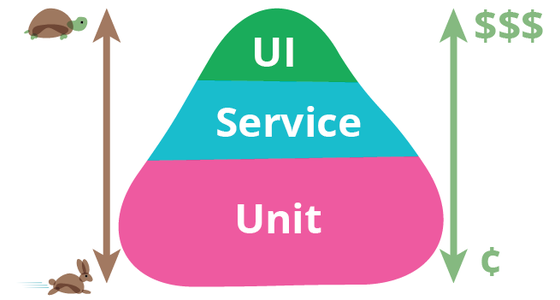
Wherever possible we want to automate. If something can be done for us by a computing machine, we don't want to spend human time on it. Humans can move on to more interesting, valuable work when existing tasks can be automated.
Consider the Test Pyramid (image right): automating lower-value tests focuses people on higher-value ones. You get more human attention and insight on the kinds of tests which best improve the value of software. You win more.
This is a sample story card with a simplistic implementation of AACs. Live buttons call back into the story system, to be mapped to calls in the testing system. (Another implementation might have the buttons directly call to the testing system, avoiding an extra call into the story system but showing details in the page source about the testing system.)
Title
Narrative
AS A AAC author
I WANT a mock executable story
SO THAT others can see the valueDetails
No actual criteria were validated in the execution of these tests. This is only a mock.
Acceptance criteria
Summary: 1 missing, 1 untested, 1 running, 1 passed, 1 failed, 1 errored, 1 disabledGIVEN magical thinking
WHEN in Missingland
THEN there's no testGIVEN magical thinking
WHEN in Newland
THEN nothing has happened yetGIVEN magical thinking
WHEN in Fastland
THEN tests run quicklyGIVEN magical thinking
WHEN in Happyland
THEN UnicornsGIVEN magical thinking
WHEN in Sadland
THEN there be DragonsGIVEN magical thinking
WHEN in Crazyland
THEN nothing works rightGIVEN magical thinking
WHEN in Slowland
THEN tests are disabled
Every AC potentially has a message from the testing system giving more detail on state. These are noted below.
This AC has no matching test in the testing system. Use the Create button to create a new test. This does not run the test.
The message is boilerplate to remind users to create tests.
The AC has a matching test in the testing system, but the test has never been run. Use the Test button to run the test.
Typically there is no message for this state.
The matching test for the AC is running in the testing system. Use the Cancel button to stop the test, or wait for it to complete.
The message, is supported by the testing system, should give a notion of progress. See REST and long-running jobs for how to do this.
The matching test for the AC passed last time it ran. Use the Test button to run the test again.
Typically there is no message for this state.
The matching test for the AC failed last time it ran. Use the Test button to run the test again.
The message must give a notion of why the test failed.
The matching test for the AC errored last time it ran. Use the Test button to run the test again.
The message must give a notion of why the test errored.
The matching test for the AC is disabled in the testing system. Update the testing system to reenable.
The message, if supported, should give a reason the test is disabled when available.
Nothing is free. Potential problems with AACs include:
There are no existing integrations along these lines. You need to build your own against JIRA, Mingle, FitNesse, Cucumber, etc. Whether the story system drives the interaction, or the test system does, may depend on the exact combination. Best would be if both systems can call the other.
As more AACs run, the complete suite takes longer. For example, adding 1 minute of AAC/story, and 5 stories/iteration, in a 12 iteration project takes 60 minutes to run. This is not specific to AACs but a general problem with acceptance tests. It's still much cheaper than the manual steps for each test, but prohibitive for a developer to run the whole suite locally.
Best practice is for the 3 amigos to run only the tests specific to a story before calling that story Ready to Accept.
Until I published this post on Blogger, I really wasn't certain how it would look on that platform. I manually tested the visuals from Chrome with the local post, and it looked good. After seeing it in Blogger, however, the "aside" sections are laid out poorly, overlapping the text. I won't relay the page: mistakes are the best way to improve, and a subtext of this post is Experiment & Learn Rapidly. Public experiements are the most faithful kind: no opportunity to fudge and pretend all was well on the first try.
After months of instability, I again have a fully working pipeline and a live web page for Sproingk, my demo project combining the latest public betas in:
If you're interested in any combination of these, please take a gander.
Kotlin (It's not just for Android!) is really where JVM programming is headed. And it's fun.
Springfox gives you a lovely UI for your REST API. (In the demo, try the "greeting controller".)
Boxfuse make minimal shrink-wrapped Linux images of your software, and handles blue/green AWS deployments.
(I talk about myself in the post more than usual. I'm expressing opinions more than usual, rather than observations and advice. Caveat lector. Also, this post is link-rich.)
After reading Eric S. Raymond (ESR)'s posts on the post-"C" world, I realized that I, too, live in that world. What would my ideal language stack look like for 2018?
For context, here are ESR's posts I have in mind:
Read them? Good. So this is the language stack I have in mind:
Each of these languages hits a sweet spot, and displaces an earlier language which was itself a sweet spot of its time:
An interesting general trend here: Not just replace a language with a more modern equivalent, but also move programming further away from the hardware. As ESR points out, Moore's law and improving language engineering have raised the bar.
(ESR's thinking has evolved over time, a sign of someone who has given deep and sustained thought to the subject.)
I have moderate experience in Python spread out since the mid-90s. At that time, I was undecided between Python, Ruby and Perl. Over my career I worked heavily in Perl (it paid well, then), some in Ruby (mostly at ThoughtWorks), and gravitated strongly to Python, especially after using it at Macquarie commodities trading where it was central to their business.
I've been a Kotlin fan since it was announced. It scratches itches that Java persistently gives, and JetBrains is far more pleasant a "benevolent dictator" than Oracle: JetBrains continually sought input and feedback from the community in designing the language, for example. Java has been my primary language since the late 90s, bread and butter in most projects. If JetBrains keeps Kotlin in its current directions, I expect it to displace Java, and deservedly so.
This is where I am relying on the advice of others more than
personal experience. I started programming with "C" and LISP
(Emacs), and quickly became an expert (things being relative) in
C++. Among other C++ projects, I implemented for INSO (Microsoft
Word multilingual spell checker) a then new specification for
UNICODE/CJKV support in C++ (wstring
and friends). I still love "C" but could do without C++. Go seems
to be the right way to head, especially with garbage collection.
With Ken Thompson and Rob Pike behind it, intelligent luminaries like ESR pitching for it, and colleagues at ThoughtWorks excited to start new Go projects, it's high time I make up this gap.
I'm looking for specific things in a "modern" language, chiefly:
Varying and strong:
You can explore the figures at TIOBE and StackOverflow.
Kotlin is the interesting case. Though low in the rankings, because of 100% interoperability running on the JVM, it's easy to call Java from Kotlin and call Kotlin from Java, so the whole Java ecosystem is available to Kotlin natively.
Further, Google fully supports Kotlin on Android as a first-class language, so there is a wealth of interoperability there. (The story for iOS is more nuanced, with Kotlin/Native including that platform as a target but in progress.)
Lastly, Kotlin/Native is bringing similar interoperability between Kotlin and Go.
(This is related to having a rich ecosystem.)
(A quick primer (2011) on garbage collection.)
Among Go's advantages over "C" and C++ is solid garbage collection out of the box, though Boehm a valiant effort. It's only been since 1959. No modern programmer—short of special cases—should manually manage memory.
Kotlin gets a head start here. It's built on the JVM (when targeting that environment), which has arguably the world's greatest GC (or at least most tested). It definitely gives you a choice of garbage collectors. There's too much to say about GC on the JVM for this post except that it is first-rate.
Python has garbage collection. Though not as strong as the JVM, it continues to improve. It is unusual for GC to become a limiting factor in a Python program; you will know if it does.
(If you are in "C" or C++, and want some of the benefits of GC, do consider the Boehm-Demers -Weiser garbage collector. No, you won't get the fullest benefits of a language built for GC, but you'll get enough to help a lot, even if just for leak detection.)
Kotlin really demonstrates where Java could improve by leaps rather than baby steps: automatic type inference. At least Java is heading in the right direction. Don't tell the computer how to run your program when it can figure this our for itself! Keep your focus on what the program is for.
Interestingly, Kotlin and Go have strong
typing out of the box, but not Python. Python
has built-in support for typing, and an
excellent optional implementation, mypy,
however this is type declaration not type
inference, so it loses a bit there. And none of the
common alternatives (Ruby, Perl, PHP, etc.) have type
inference either. I'll need to check again in a few years, and
possibly update this choice.
(Paul Chiusana writes on the value of static type checking.)
Of the languages, Kotlin is a standout here. Because it is a JVM language, it is 100% compatible with Java, and can fully use the rich world of Java libraries and frameworks. The main weakness for Kotlin is lack of tooling: because more advanced tools may make assumptions about bytecode, Kotlin's particular choices of emitted bytecode sometimes confuse them.
(JetBrains has surveyed on the state of ecosystems for programming languages, related to having a good community.)
Close behind is Python, "batteries included" and all, and it has a better organized and documented standard library than Java. For some problem domains, Python has a richer ecosystem, for example, SciPy and NumPy is the best math environment available in any language. (Some specialty languages like MATLAB deserve mention—an early employer of mine.) I may need to reconsider my ranking Kotlin over Python here.
Go is, frankly, too new to have developed an equivalent ecosystem, and full-blown package management is still a work in progress.
A common thread in recent language development is lower ceremony: fewer punctuation marks and boilerplate; make the machine do more work, you do less. Kotlin provides the most obvious example compared to Java. Go is know for cleanness and brevity. And Python ranks high here as well.
(Donnie Berkholz writes an interesting post on ranking language expressiveness.)
The classic "Hello, World!" showing three things:
This doesn't, of course, give a sense of how these languages in their full spectrum, but does give a first taste.
Java in a file named MyStuff.java:
package my.stuff;

public final class MyStuff {
    public static final String LANGUAGE = "Java";

    public static void main(final String... args) {
        System.out.println(String.format("Hello, World, from %s", language));
    }
}
Kotlin in a file named my-program.kt:
package my.stuff

const val LANGUAGE = "Kotlin"

fun main(args: Array<String>) = println("Hello, World, from $LANGUAGE")
But also compare Go to C++:
package main

import "fmt"

const Language = "Go"

func main() {
    fmt.Println("Hello, World, from", Language)
}
And C++:
#include <iostream>

int
main()
{
  std::cout << "Hello, World!" << std::endl;

  return 0;
}
And for completeness, Python compared to Perl and BASH:
#!/usr/bin/python

language = 'Python'

print('Hello, World, from {}'.format(language))
Any Perl:
#!/usr/bin/perl

use strict;
use warnings;

my $language = "Perl";

printf("Hello, World, from %s\n", $language);
Unfairly simple:
#!/bin/bash

language=BASH

echo "Hello World, from $language"
As usual, I never catch as many problems in my writing as I do
after reading it posted publically. Many small edits, and an
added, explicit mention of wstring.
(This post follows up on Frequent commits, a post about git command line help for TDD. I assume you are already following good TDD practices. Also, please recall git normally requires pulling before pushing if your repo is behind on commits from the remote.)
I'm chatting with a colleague who is new in her role as an Agile Coach (she comes from a PM background). We were talking about ways to organize a team's story board (card wall), and turned to Desk Checks and when they fit into a story's life.
An interesting remark by her: a team had agreed to share work (push) only after the desk check was successful; that is, they did not push code until a story was almost done: work lay fallow on individuals' machines for potentially days at a stretch.
I was surprised. Why would they wait days to push—what did they do about merge conflicts, complex refactorings, integration failures in the pipeline, et al?
To me this was clearly a smell. Martin Fowler specifically addresses this in Everyone Commits To the Mainline Every Day, and I would go further: Push commits at the earliest responsible moment. This is opposite the advice for refactoring, or especially emergent design, where the "Rule of 3" and last responsible moment cautions waiting for more information before committing to a course of action.
And you can see why early pushes differ from the other two: waiting will not get you more information. On the contrary, waiting will only increase the entropy of the code base! Commits lie fallow in the local repo, increasing the size of potential merge conflicts for others.
| Benefit from more information? | Principle | Entropy from waiting | |
|---|---|---|---|
| Early push | None available | Earliest responsible moment | Rises from fallow commits |
| Refactoring | Get more code examples | Rule of 3 | Falls after refactoring |
| Architecture decision | Learn more about system | Last responsible moment | Falls if responsible |
(The "information" in the case of pushes are the pulled commits themselves.)
I've definitely experienced this firsthand, when I'd eventually discard my local commits after waiting too long, and letting them grow too much in a different direction from how the rest of the team progressed. Waste!
Consider this work cycle:
I've grouped these to emphasize what is local to you (the first four) and what is global to your team (the last one).
Considered only locally, you minimize entropy with frequent pulls for yourself, and likewise for your teammates individually, so you can catch merge conflicts early and resolve them when they are small. But considered globally, you need frequent pushes so those local pulls have only small changes in them. The longer you wait to push, the more work for those who pull.
| You | Rest of team | Work for others |
|---|---|---|
| You commit | ||
| You push | ||
| They pull | Less complexity of merge (1 commit) | |
| You commit | ||
| You push | ||
| They pull | Less complexity of merge (1 commit) |
Each single push can be treated on it's own. There are two opportunities for merge conflict, but each is a small amount of work.
| You | Rest of team | Work for others |
|---|---|---|
| You commit | ||
| They pull | No changes to merge | |
| You commit | ||
| You push | ||
| They pull | Greater complexity of merge (2 commits) |
In each scenario, there are two commits for others to contend with. The larger, combined push has a greater opportunity for merge conflict, and a greater chance for a large amount of work, because of the combined interactions of the two commits.
And as teams work in parallel, there are more opportunities for merge conflicts.
From the above discussion, the safest course is to push early rather than wait as commits pile up locally. But when to push—what is the "earliest responsible moment"?
If your codebase is well-tested, and answer presents itself: Push when tests are green and changes alter the complexity.
The goal is to avoid complex commit interactions that lead to merge conflicts. Tests are the safety net. Further, if all else fails and a commit is bad, it is easy to throw away the last commit until things are right again: only a small amount of work is lost, not days worth.
Understanding what kind of changes alter complexity takes skill: skills improve with experience and coaching. The cost of early pushes is low, and the occassional penalty of late pushes high, so this would be a good topic for a "team norms" ("dev practices") discussion.
For example, the team might agree that changes to comments are not in themselves worth a push. At the other end, your refactorings which impact more than one source file almost certainly should be pushed early: discover their impact on others before you add more refactorings.
A good work cycle:
After a preliminary sanity check (#1 and #2), get in the the cycle of #3 to #6.
I checked with other teams: it is minority practice to wait until a successful desk check to push changes. That's a relief. Hopefully this practice can be made more rare.
One rational reason—itself a smell—is when tests take too long to run frequently. When I design a pipeline, I recommend breaking out "unit" tests from "integration" tests for this exact reason: even when integration tests run long, the initial CI stage with just unit tests should be fast enough to give quick feedback on frequent pushes, and encourage Push early, Push often, Push on (local) green.
[1] The simple statement, "a greater chance for a large amount of work", has rather complex reasoning behind it, beyond the scope of this post.
For example, any particular commit can be viewed as applying an exponent to the overall complexity of a program. A neutral change (say, correcting a typo in a comment) has the exponent 1: it does not change the overall complexity; a positive change (say, removing code duplication) has an exponent between 0 and 1: it lowers the overall complexity; a negative change (say, adding a new dependency) has an exponent greater than 1: it raises the overall complexity.
Consider then that these complexity changes are not simple numbers, but distributions ("odds"), and change with time ("bitrot"), and involve more than the code (people or requirments changes).
[2] In Seth's post, do not confuse "publish once" with "wait to push": it means "don't publish the same commit twice" (which does sometimes happen accidentally, even for experts, from merging or rebasing).
Sure enough, right after posting I read an interesting discussion on the value of the statistical mean (average) relevant to the discussion on two commits taken separately or together.
Essentially, even when the merge conflict work averages out over time for pushing two commits separately versus pushing them together, the outliers for pushing them together is significantly worse than for pushing them separately because of interactions and complexity.

